The People Behind the Pen
we should be celebrating ghostwriters
October 20, 2026
The best songwriting stems from a song’s ability to evoke emotion through the combination of words, rhythm, melody, and overall sound. Frank Ocean’s “Self Control,” for example, can evoke sadness in the same person that Playboi Carti’s “Magnolia” evokes joy. “Self Control” takes the listener through a journey of longing and inevitable surrender, while “Magnolia” provokes confidence and an instinctive bounce. Good songwriting can come from strong uses of literary devices and narrative, but it can also come from catchy vocal textures, hypnotic melodies, and mantra-like repetition. It’s not easy to make a song that resonates with people — it’s multilayered. It relies on mechanics that many artists may not even realize they’re using when they do it.
This is why being a music performer and being a songwriter are not necessarily the same thing. An artist can have a distinct artistic voice without writing every song they perform. Many performers work with writers, including ghostwriters, and collaborate with notable songwriters and producers to create music that fits their sound, perspective, and artistic identity. Behind some of our favorite voices are people whose names we may not recognize but whose words, melodies, and ideas have become essential to the music we love.
When you look at the credits to your favorite songs and albums, there might be a laundry list of people who contributed to the project. This isn’t bad at all — multiple creatives put their minds together and made the art you’re enjoying. Collaboration has brought forth the majority of the music you listen to. Upon these project collaborators are songwriters, who write lyrics that fit the drums of the beat or arrange melodies that turn into the catchy choruses everyone knows. They understand how to choose melodies and lyrics that are pleasant to listen to against the production. Most importantly, they’re writing in the voice of the performer. Songwriters sometimes write with a performer in mind to sell the song to or work on the song with. They adopt the performer’s persona or sound and create music that aligns with how the performer shows up in the industry. When everyone found out Lil Yachty wrote the majority of City Girls’ “Act Up”, it was funny to imagine Yachty listening to the beat and penning a feminine and sassy song. No matter what his inspiration was, it fit the City Girls perfectly and became one of their biggest hits because, as a songwriter, Yachty understood how the City Girls could interpret ‘Act Up’.
It takes strong musicality to write a song and know it would be perfect for someone else, despite being a performer yourself. Stevie Wonder is one of the best musicians of all time — he truly understands music and sound at deeper levels than the average person. His songwriting skills match that understanding, as made evident by the hits he has written for himself and others. He writes high quality songs with compelling composition, beautiful lyrics, and memorable melodies. He writes hits for himself, and other artists, and has the discernment to determine which ones should be Stevie songs and which could be someone else’s. He wrote for Michael Jackson, Rufus and Chaka Khan, Roberta Flack, Aretha Franklin, and countless other legendary R&B, soul, and pop artists. Industry icons tapped Stevie to help complete albums and leaned on his gift for chord structure, melody, and lyricism to add another layer of magic to their music. Stevie Wonder is one of the most prolific musicians to ever do it, and his songwriting is a major part of what makes his legacy so undeniable.
Another performer-songwriter who deserves far more recognition than he receives is Babyface. With a catalog filled with timeless classics, his influence on R&B is hard to overstate. Babyface helped shape multiple eras of the genre, but his impact on ’90s R&B especially stands out — a period many consider to be the “golden era” of R&B. If you look at the 1990s Grammy Awards nominations in the R&B categories, there’s a 9 out of 10 chance Babyface is in the category as a writer or for his own music. In 1995, Babyface competed for Best Rhythm & Blues Song award and he was nominated three times in the category — he ended up winning for “I’ll Make Love To You,” but the odds were in his favor regardless. Apart from his own fruitful career as a performer, Babyface’s legacy lies in his songwriting success. The caliber of musicality he possesses naturally led him to write for more artists, including Whitney Houston, Brandy, Boyz II Men, TLC, Madonna, and Charlie Wilson. He and L.A. Reid teamed up to create LaFace Records, which signed Outkast and changed the trajectory of hip hop forever. This same label launched Usher, Toni Braxton, TLC, Goodie Mob and Donell Jones, solidifying its legacy on R&B and hip hop. Although Babyface and L.A. Reid share the notoriety of the work done at LaFace Records, Babyface’s writing credits are untouched. Babyface himself considers himself a songwriter before anything else, so it came to no one’s surprise when he was inducted into the Songwriters Hall of Fame in 2017. Babyface, like Stevie Wonder, plays multiple instruments and sings, which complement and help develop the songwriting skills it takes to create a hit song and notable projects. He wrote and produced Whitney Houston’s “Exhale (Shoop Shoop),” recognizing how Whitney’s captivating voice could take the song further. He also did that for the entirety of the Waiting to Exhale (1995) soundtrack, writing and producing songs for Brandy, SWV, Aretha Franklin, Mary J. Blige, Patti LaBelle, and more vocalists to create a sound fitting the themes of the film. This album received 11 Grammy nominations, entered the Billboard 200 chart at #3, and was certified 7x Platinum. That’s the level of success a great songwriter can produce.
When reading Babyface’s interviews, he highlights his songwriting experience as the primary driver of his career, despite his success as a solo recording artist. Given that he began songwriting in the sixth grade as a way to cope with the woes of childhood, he took songwriting seriously at a young age and developed the muscle as he wrote for other acts. In the past few decades, Babyface has written for contemporary artists across pop and R&B, such as Sza, Ty Dolla $ign, Ariana Grande, Beyoncé, and Justin Bieber.
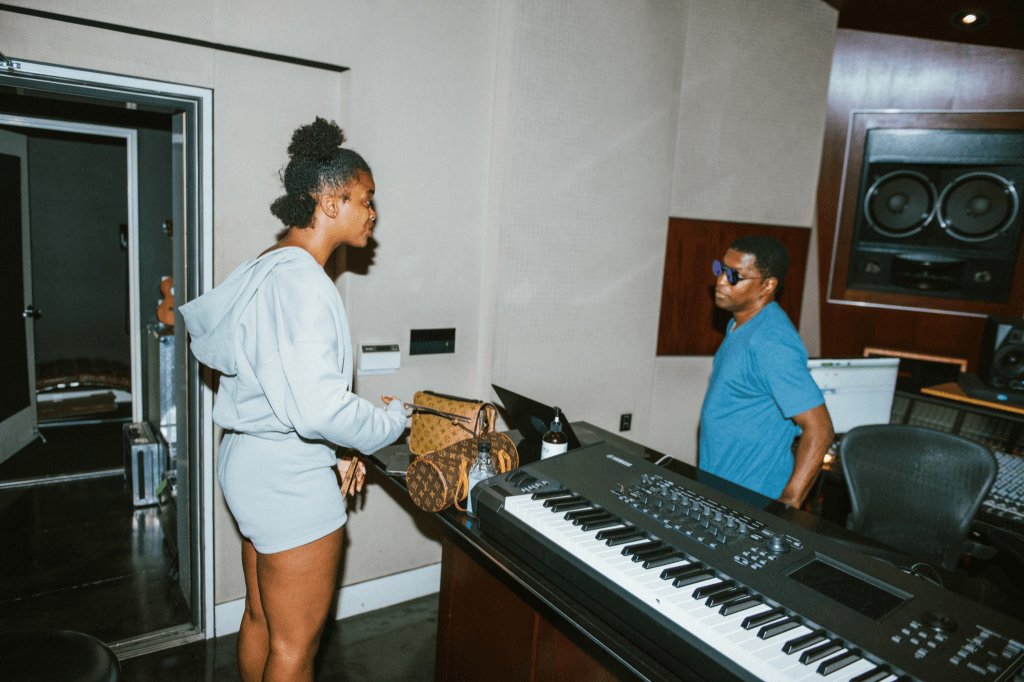
Babyface and Ari Lennox in the studio together. PC: ThatGrapeJuice.net
Ester Dean, nicknamed “The Song Machine” in 2012, wrote hits for artists like Rihanna, Nicki Minaj, and Beyoncé, contributing tremendously to the “recession pop” era and overall late 2000s/early 2010s sound that took over the Billboard charts. Songs like Nicki Minaj’s “Super Bass,” Katy Perry’s “Firework,” Selena Gomez’s “Come & Get It,” and Rihanna’s “Rude Boy,” defined the 2009-2013 pop music scene through their catchy lyrics, synth-pop rhythms and similar yet varied aesthetic that created musical and visual eras. Although Ester wrote for different pop stars and helped them form their identities against competitors (which she also likely wrote for), being a common thread among so many artists created a sound in pop and R&B that feels specific and nostalgic today. Labels and artists hire the hit makers of the industry, like Ester, to help write songs they know will blow up. Sometimes, the writers themselves put together songs and already know which artists they want to sell them to. They can also be pressured to write songs that fit formulas for a viral song, signature artist sound, or trends within a genre. That’s how we get eras where different acts are performing similar songs, themes, and melodies.
In hip hop, songwriting is treated differently. There’s a shame associated with songwriting that other genres don’t experience as much. Rappers and hip hop artists are expected to be the sole writers of their verses and songs, so when their credits show a list of contributors, public perception of that rapper’s pen ability can become negative. Drake, for example, has made music across multiple genres and has even written for other singers and rappers (see: Beyoncé’s “Heated” and Ye’s “Yikes”), but he faced scrutiny when Meek Mill accused him of having ghostwriters in 2016. Drake has also been rumored to ghostwrite for Lil Wayne, who’s been rapping since he was eight. Kanye West has been accused of having several ghost writers and credited writers who write all his verses, such as CyHi and Rhymefest. A lot of rappers have been accused of having writers or ghostwriters to help them put together some of their biggest songs and albums. The reality is, many of the rumors are likely true. However, a rapper having other writers contribute to their music shouldn’t be as scandalous as it is. There’s a reason artists across all genres have teams of contributors and songwriters. Songwriting isn’t easy, especially for artists who have been in the music industry for decades and put out albums after albums. The expectation is that rappers, like other musical acts, release different sounds with every song and album. There are formulas to successful songwriting, which may include catchy hooks, easy to rap along to verses, and melodic choruses. Since the art of rapping is mainly rooted in lyrical ability, it seems reasonable to shame a proclaimed rapper that may not write all of their lyrics. But, a different perspective is that rap is not just a music form focused on content. It is delivery, rhyme schemes, production, flow, performance, storytelling. When you see a rapper’s credits include a list of people, note that a contributor is typically credited whether they contribute one line or two verses. They might’ve just been in the room, helping drive the direction of the music. Maybe they’re a songwriter completing lyrics or maybe they’re not credited at all and they wrote the entire song. Sometimes, a rapper needs a writer — this doesn’t diminish their talent. Rapping requires personal flair through performance cadence, delivery energy and ad libs. Maybe if there was less shame around collaborative writing in rap, we’d be able to shine a greater light on songwriters that deserve recognition for their work.
The Songwriters Hall of Fame started in 1969 as a way to honor and recognize those who made successful careers in writing across many musical genres while uplifting the next generation of songwriters. A songwriter is eligible for the HoF 20 years after their first commercial release and only if they have a notable catalog throughout their career. Only 513 songwriters across all genres have been inducted into the Songwriters Hall of Fame since 1969.
Maybe it’s time we paid more attention to the people behind the pen. The next time you memorize a verse, sing a hook, or run an album back, take a look at the credits. You might be surprised by who’s responsible for the music you love.
