
R&B Singers Need The Church
August 9, 2025
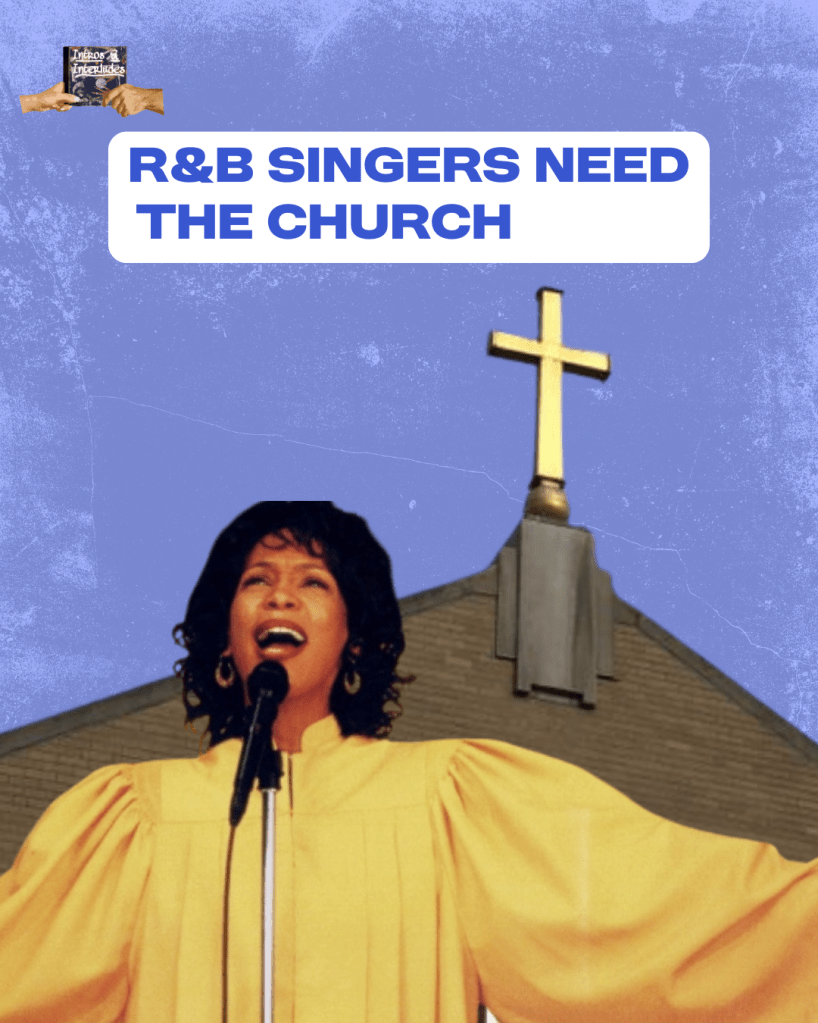
This isn’t religious propaganda, it’s an observation on the evolution of singing ability in R&B. The greatest R&B singers didn’t just come from the studio—they came from church.
Usher, Beyoncé, Brandy, Mary J Blige, Fantasia, D’Angelo, Jennifer Hudson. We know them as iconic R&B singers of the 2000s, but they also all have a common ground in their careers—church roots. It’s not a coincidence that a lot of the greatest R&B singers of all time began in the church. Whether their parents were devout religious leaders, they sang in church choirs, or just went to religious institutions growing up, they grew up in church. In a blog post Frank Ocean wrote during his Tumblr days, he writes that he didn’t sing in church because he was intimidated by it because all of the coolest musicians came out of it, calling it the ‘hood julliard’… and he was right. Church origins are common for powerhouse and vocally trained singers. Imagine being 10 and having your first live performance being in front of a group of people united by spirit and psychological connection.
Church music is full of emotion and power, people are moved by lyrics that connect them to their spiritual belief. Gospel lyrics repeat Bible verses, prayers, and parables, driving the emotional impact of religious text. Mix that impact with the acoustics in a church building, the vocal blending of people who create an intricate and resonant frequency, and the technical skills of singing, such as deep breathing and vocal vibrations.
Not every great modern singer grew up in church. We’d be lying if we said you have to go to church to sing well. Some people were born gifted and trained their voices in other ways. Ariana Grande is one of the best technical vocalists of this generation, but she grew up Jewish. Ariana Grande also grew up on Broadway theatre, a performance category known for ballads, emotional singing, and vocal power. Adele didn’t grow up attending church either, but she did attend a performing arts high school in England (alongside two other powerful singers—Leona Lewis and Jessie J). Mariah Carey wasn’t in church growing up, but she did get training from her mother—a classically trained opera singer. There are definitely other amazing vocalists who received training outside of church, so our thesis is merely a theory, but the proof is undeniable.
That said, for most R&B singers—especially in the Black community—the church wasn’t just background noise. Choir was how kids participated in church, a tradition passed down for generations to encourage closeness to God and service to the church. It was where you learned to sing, perform, and move people all at once. More than just a building, the church is a pillar in the Black community, and its culture of performance shaped these singers. Gospel music didn’t stop at Sunday service—it was the soundtrack to Sunday cleaning and weekday rides to school. Pair that with R&B and Blues from earlier generations, and kids had endless opportunities to practice and sharpen their voices. Churches taught call-and-response, live improvisation, little room for error, and layered vocals. That’s why so many R&B singers share similar technical styles: intricate runs, falsettos, melisma, and raw emotion. They could say just a few words and make them mean everything by the way they sang them.
Singers like Stevie Wonder, Katy Perry (not traditionally R&B but still an amazing vocalist), John Legend, Whitney Houston, Justin Bieber, Maxwell, and Tori Kelly all sing differently but have incredible vocal range and ability. That overlap isn’t accidental—they trained. They say practice makes perfect because it does. But, natural talent plus intense vocal training makes for a legendary singer. It makes for good live performances and memorable vocal runs that everyone tries to sing but can’t.
There are a lot of successful R&B singers that didn’t grow up in church or have vocal training, but they have a natural or unique singing ability. You don’t have to be a powerhouse (or an amazing vocalist) to sing R&B. This genre of music is about lyricism, melodies, and emotion. And because R&B itself has so many subgenres and blends—from alt R&B to trap-soul to neo-soul—the vocal approach can range too. Some styles lean heavy on raw vocal power, others are more about vibe, delivery, or mood. I wrote more about that in this piece on R&B subgenres. But, if you’re an R&B singer who wants to be a powerhouse, you have to go through training and learn vocal discipline. Although church doesn’t create talent, it does shape and amplify it. Not every singer needs the church, but the R&B we know and love wouldn’t be the same without it.
